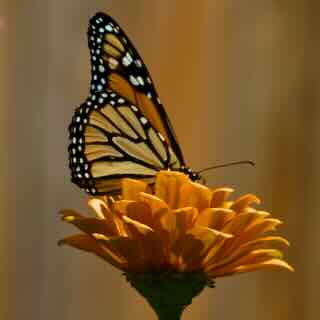
Leya wrote: “For this challenge, this week, I want to give us more freedom by using a wider explanation of the concept: Harmony is the combination of separate but related parts in a way that uses their similarities to bring unity to a painting, drawing, or other art object.” Like, perhaps, an orchestra?
From harmony, from heavenly harmony
This universal frame began:
When nature underneath a heap
Of jarring atoms lay,
And could not heave her head,
The tuneful voice was heard from high,
Arise, ye more than dead.*
Do you play a musical instrument? Or, did you when you were in school? I did, I studied piano so now, and evermore, the word harmony is linked to music. For this lovely challenge by Ann-Christine (fondly Leya), I’m taking my inspiration from what was originally a song, now a poem, by John Dryden, which begins with the famous line From Harmony, from heavenly Harmony, This universal frame began. Written in 1687, Mr. Dryden’s classic poem explores the idea that the entire universe was created from cosmic musical harmony. With a good amount of creative license, I’ve tried to match my photographs with his muses – Jubal, the trumpet, the drum, the flute, the violins and the organ.
2nd Stanza “Jubal”

When Jubal struck the chorded shell,
His listening brethren stood around,
And, wondering, on their faces fell
To worship that celestial sound.*
In both folklore and biblical traditions, Jubal is regarded as the inventor of stringed and wind musical instruments. He is mentioned in the Book of Genesis: And his brother’s name was Jubal: he was the father of all such as handle the harp and organ.† ‘Though the dried mud curls mirror the shape, frequency, and movement of the sound waves and musical rhythms described in Mr. Dryden’s poem, I fancied that the way the mud is curled and peeling upward looks exactly like an audience rising up.
3rd Stanza “Trumpet”

The trumpet’s loud clangour
Excites us to arms,
With shrill notes of anger,
And mortal alarms.*
The pattern of the shattered windshield glass radiates outward from a central point in sharp, chaotic fragments looking, I hope, like a visual explosion of sound. The concentric circular cracks rippling outward are my representation of the intense, piercing sound waves of a trumpet’s blast.
3rd Stanza “Drum”

The double double double beat
Of the thundering drum
Cries, hark! the foes come;
Charge, charge! ’tis too late to retreat.*
There is a magnificent, booming power in waves violently colliding with stone — akin to the sudden, explosive impact of a heavy mallet striking a massive bass drum. The jumping seawall wave, exploding into the air, is my representation of a thunderous drum crescendo. The towering plume of white spray looks exactly like a visual shockwave. It bursts upward with an untamed, thunderous energy that I hope makes you hear the thundering drum in your mind.
4th Stanza “Flute”

The soft complaining flute
In dying notes discovers
The woes of hopeless lovers,
Whose dirge is whisper’d by the warbling lute.*
This is a shot of water over rocks, in Presqu’ile Bay, on the north shore of the provincial park. The surface pattern caught my attention and, to this day, I’ve no idea what caused it. In my imagination, those elegant, ribbon-like loops look exactly like an oscilloscope reading, or a continuous musical staff, or a lingering sound frequency traveling across a deep background. Fancifully, they appear almost as if the musical harmony of the universe became momentarily visible on the surface of Lake Ontario.
These thin, delicate, fluid lines on the surface of the water are my interpretation of a soft woodwind harmony, drifting away into silence. The contrast between the sharp, abstract loops on the surface and the soft, grounding stones visible beneath the water creates a dual layer, hopefully capturing Mr. Dryden’s idea of a complex, layered universe built on “heavenly harmony.”
5th Stanza “Violins”

Sharp violins proclaim
Their jealous pangs, and desperation,
Fury, frantic indignation,*
The long, thin, curved stem of the Bottlebrush Grass looks remarkably like a bow’s arched path as it is drawn across a violin. The delicate, sharp awns radiating off the stem mimic the instrument’s fine strings. The way they contrast so sharply with the pitch-black background illustrates, I hope, Mr. Dryden’s sharp note of desperation.
The pointed tips represent Mr. Dryden’s jealous pangs but the entire frond represents both the instrument and the emotions it evokes. Mr. Dryden uses words like fury and frantic. Bottlegrass is what I imagine a furious and frantic explosion from the First Violins might look like.
6th Stanza “Organ”

Notes inspiring holy love,
Notes that wing their heavenly ways
To mend the choirs above.*
I chose this image because I fancy that the brilliant, glowing shafts of light cutting diagonally through the canopy perfectly visualize Mr. Dryden’s lines and the tree trunks symbolize the organ’s pipes. It seems a big ask to photographically represent the amazing sound and breadth of organ music, but to me, a forest seems best-suited to that task.
Thanks to Ann-Christine for envisioning such a cerebral challenge for us this week. It made me think a lot and for my interpretation, I enjoyed trying to find pictorial representation of musical instruments and their sounds. A-C’s post is visually stunning; please take a moment to visit her post and admire her brilliant photography — it’ll be the best part of your day, promise:
Lens-Artist Challenge #414 – Looking Back to #44 -Harmony
’Til next time, y’all…
*John Dryden from his poem “A Song for St. Cecilia’s Day” — page 186, “Songs, Odes, and a Masque” from his anthology “The Poetical Works of John Dryden, Volume 2”. Appointed by King Charles II, Mr. Dryden was England’s first Poet Laureate. Full text below.
†Holy Bible, Genesis 4:21, KJV.
A Song for St Cecilia’s Day
FROM harmony, from heavenly harmony
This universal frame began:
When nature underneath a heap
Of jarring atoms lay,
And could not heave her head,
The tuneful voice was heard from high,
Arise, ye more than dead.
Then cold, and hot, and moist, and dry,
In order to their stations leap,
And Music’s power obey.
From harmony, from heavenly harmony
This universal frame began:
From harmony to harmony
Through all the compass of the notes it rail,
The diapason closing full in Man.
What passion cannot Music raise and quell?
When Jubal struck the chorded shell,
His listening brethren stood around,
And, wondering, on their faces fell
To worship that celestial sound.
Less than a God they thought there could not dwell
Within the hollow of that shell,
That spoke so sweetly and so well.
What passion cannot Music raise and quell?
The trumpet’s loud clangour
Excites us to arms,
With shrill notes of anger,
And mortal alarms.
The double double double beat
Of the thundering drum
Cries, hark! the foes come;
Charge, charge!’tis too late to retreat.
The soft complaining flute
In dying notes discovers
The woes of hopeless lovers,
Whose dirge is whisper’d by the warbling lute.
Sharp violins proclaim
Their jealous pangs, and desperation,
Fury, frantic indignation,
Depth of pains, and height of passion,
For the fair, disdainful dame.
But oh! what art can teach,
What human voice can reach,
The sacred organ’s praise?
Notes inspiring holy love,
Notes that wing their heavenly ways
To mend the choirs above.
Orpheus could lead the savage race;
And trees uprooted left their place,
Sequacious of the lyre:
But bright Cecilia raised the wonder higher:
When to her organ vocal breath was given,
An angel heard, and straight appear’d,
Mistaking earth for heaven.
Grand Chorus.
As from the power of sacred lays
The spheres began to move,
And sung the great Creator’s praise
To all the bless’d above;
So when the last and dreadful hour
This crumbling pageant shall devour,
The trumpet shall be heard on high,
The dead shall live, the living die,
And Music shall untune the sky.
Footnotes:
[Footnote 43: ‘St Cecilia’s Day’: 22d November-birthday of St Cecilia, the patron saint of music-a Roman lady martyred in the third century, said to have been taught music by an angel.]


Leave a Reply