

My lemons are syncopes. An overwhelming number of them, occurring nearly every day this year, numbering between fifteen and fifty each day. Every instance completely without warning. It is overwhelming and has clipped my wings.
Rather than venturing out to the parks, conservation areas and marshes to observe and shoot wildlife, I’ve had to content myself with those creatures in the garden. But this is where kindly Kismet stepped in on my behalf. We have a pollinator garden this year, so the bulk of the wildlife I have to work with has been the variety of bees, wasps, hornets and hoverflies that visited our flowers. Coincidentally, the school outreach programme for the 2025/26 school year (for grades 7 and 8) is the amazing contributions made by pollinators, and the value of creating pollinator gardens to lure them. The request came to me early this spring – do I have ample bee pictures and would I help (read: I’m the only participant so far) create a presentation with my images.
You’ve no idea how wonderful it is to have a tailor-made project (photography, wildlife, wildflowers) that I can comfortably complete without having to leave home! This presentation is my lemonade. It brought me a lot of satisfaction and joy and for that I am grateful beyond words.

And as it works, th’ industrious bee
Computes its time as well as we.
How could such sweet and wholesome hours
Be reckon’d but with herbs and flow’rs!*
The dedicated and hard-working garden volunteers in our condominium complex have designed, planted and nurtured a pretty, native, pollinator garden beside our laneway. I’ve spent a lot of time this summer, observing and documenting the surprisingly vast number of pollinators that have visited our wee garden and their foraging activities. In researching my “lemonade project”, I’ve learned a lot about the lives of these pollinators.
‘Though I’ve now counted more than twenty species, the three most common visitors (all “workers”) seem to be:
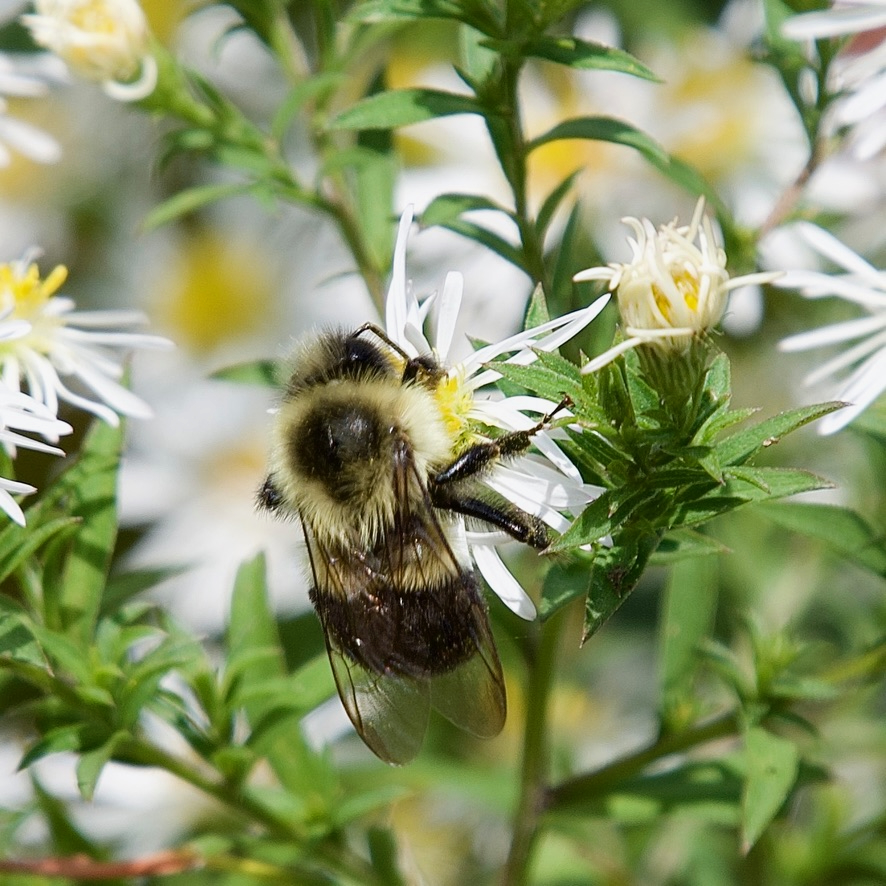
Common Eastern Bumblebee (Bombus impatiens)
Lifespan: Four weeks.

Western Honey Bee (Apis mellifera)
Lifespan: 30-60 days.

Northern Paper Wasp (Polistes fuscatus)
Lifespan: 20-40 days.
Not all pollinator knowledge can be gleaned from books. Mine accumulated from a series of observational experiences which combined to provide a greater understanding of the lives of these eco-heroes. The way our garden has been laid out, I was able to nestle into the flowers, touching them even, without harming them. It put me in very close contact with the pollinators, many times they were less than two inches from me which took great courage on my part: I am allergic and I do not, at the moment, have an epipen. I could hear their buzzing and the sound of the beating of their wings and I could see details I’d never before noticed. Pure fascination and bewitchment! Mum and Dad taught me to move slowly, and to carefully watch and listen to the natural world around me. Without fail, each time I heed that advice, I am overwhelmed with wonder. It is a powerful experience.
In the final stages of their lives (usually at or near the 21 day mark), the workers’ lives are dedicated to foraging for pollen and nectar. Purposeful foraging: The typical colony needs more than 200 pounds of honey each year to survive. This work demands diligence and fortitude, and the workers can make as many as 15 trips a day to the flowers and back to the hive. This tenacity does involve some fighting for access to the best and most plentiful blossoms.
By observing their busyness, I learned is that there is a distinct hierarchy amongst the pollinators. The biggest bee (by both size and population) in our garden is the Bumblebee but, rather than being the dominant species, it is the most timid and is chased away from the premium nectar and pollen sources by all the others. The biggest overall pollinator species in our garden is the Paper Wasp and they fight the poor Bumblebees ferociously! Smaller than both of those species is the Honeybee, yet these are the the clear rulers, proving once again that size doesn’t matter. The Honeybees are the indisputable bosses of the blossoms; all other insects (butterflies and moths, included) give way to them.

Common or Tall Yarrow (Achillea distans)
Nature-connectedness is an enormous part of my life and, whilst that usually involves spending hours and hours in the woods, beside a creek or at a marsh, this year that didn’t happen for me. But nature is so much more than just being in the wild or untamed spaces, it is also the trees, plants, birds, insects and animals that inhabit or visit our gardens. Learning and living that lesson was my lemonade this summer. Actively engaging and connecting with nature is important to me because it lowers my stress level, elevates my mood, and wraps me in serenity.
Fate definitely sent me lemons this summer — I was unable to spend any time alone at Wheatley PP, Hillman Marsh CA, and Point Pelee NP. But spending time in the tranquility of our laneway garden, steeped in its beauty, and observing the beauty and industry of the visiting pollinators was my way of making lemonade. My garden time boosted my reserves of strength and determination and both of those have been much-needed.
’Til next time, y’all…
*Andrew Marvell from his poem “The Garden” — page 24 from his anthology Complete Poetical Works of Andrew Marvell.
†Elbert Hubbard. ’Though often attributed to Dale Carnegie, this proverb was coined by Mr. Hubbard in a tribute he wrote about actor Marshall Pinckney Wilder upon his death in 1915, some 30+ years prior to Mr. Carnegie’s use in his book.
Marshall Pinckney Wilder was born with achondroplasia or dwarfism and also with kyphosis or curvature of the spine. He became the first celebrity who attained fame in spite of his disability. He wrote a lot and always signed his letters, “Merrily Yours!”
The obituary is very touching:
He was a walking refutation of that dogmatic statement, Mens sana in corpore sano. His was a sound mind in an unsound body. He proved the eternal paradox of things. He cashed in on his disabilities. He picked up the lemons that Fate had sent him and started a lemonade-stand.
 Enchanting Essex
Leave a comment